Dear Crafty Readers,
“I’ve been sewing long enough that people now treat it like a personality trait instead of a skill.
Somewhere along the way, ‘you sew’ turned into ‘you should teach.’
Friends mention it casually. Family assumes it. Coworkers bring it up over lunch.
‘You could show me sometime.’
‘It wouldn’t take long.’
‘You’re so good at it — you’d be a great teacher.’What they don’t realise is that teaching sewing drains me in a way sewing itself never does.
I don’t enjoy explaining basics. I don’t like being responsible for someone else’s frustration. And I don’t want my creative time to turn into unpaid lessons.
When I say no, people are surprised. Some are offended. A few act like I’m withholding something I owe them.
So now I’m questioning myself.
Am I the asshole for not wanting to teach sewing just because I know how?
— Anonymous
This question taps into something deeper than sewing.
It touches on expectations, emotional labour, and the strange idea that being skilled automatically makes you responsible for everyone else’s learning.
When “Sharing Your Skill” Stops Feeling Generous
There’s a lovely idea floating around the crafting world that skills should be shared freely. And sometimes, that is a beautiful thing.
But sharing only feels generous when it’s voluntary.
When teaching becomes expected, assumed, or repeatedly requested, it stops feeling like kindness and starts feeling like obligation.
And obligation has a way of draining joy — fast.
Teaching Is a Skill of Its Own
One of the biggest myths here is that being good at sewing automatically makes you good at teaching it.
It doesn’t.
Teaching requires:
- Patience
- Clear communication
- Emotional regulation
- The ability to troubleshoot someone else’s mistakes without frustration
Many talented sewists simply don’t enjoy that role — and that doesn’t make them selfish or unkind. It makes them self-aware.
The Emotional Load No One Talks About
What people often forget is that beginner sewing comes with:
- Frustration
- Self-doubt
- Repeated mistakes
- Emotional reactions when things go wrong
When you teach, you don’t just explain stitches — you absorb someone else’s emotions.
That’s a lot to carry, especially if sewing is your own way to decompress.
“But It Would Only Take a Few Minutes…”
This phrase shows up again and again — and it’s almost never true.
A “quick lesson” usually turns into:
- Setting up machines
- Explaining terminology
- Undoing mistakes
- Repeating instructions
- Managing disappointment
What was meant to be a casual favour becomes a full mental commitment.
Why Saying No Feels So Uncomfortable
Many sewists say yes not because they want to — but because they feel guilty.
There’s an unspoken pressure to:
- Be helpful
- Be encouraging
- Be the “nice” creative person
Saying no can feel like rejecting the person, not just the request. And that’s where the guilt creeps in.
Is Sewing Knowledge Something You Owe?
This is the heart of the debate.
Some people believe that skills should be shared freely, especially traditional ones like sewing.
Others believe that no one is entitled to your time, energy, or expertise — especially when there are books, classes, videos, and tutorials readily available.
Both perspectives exist — and neither is inherently wrong.
The Difference Between Teaching and Encouraging
Here’s a middle ground many sewists land on:
You can encourage someone to sew without becoming their teacher.
Recommending a YouTube channel.
Suggesting a class.
Pointing them to a beginner pattern.
Support doesn’t have to mean personal instruction.
So… Are They the Asshole?
This is where opinions diverge — sharply.
Some readers will say:
- “If you know how, why not help?”
Others will say:
- “Teaching is work. No one is owed that.”
And many will quietly think:
- “I wish I’d learned to say no sooner.”
Over to You, Crafty Readers
Now let’s hear from you — honestly.
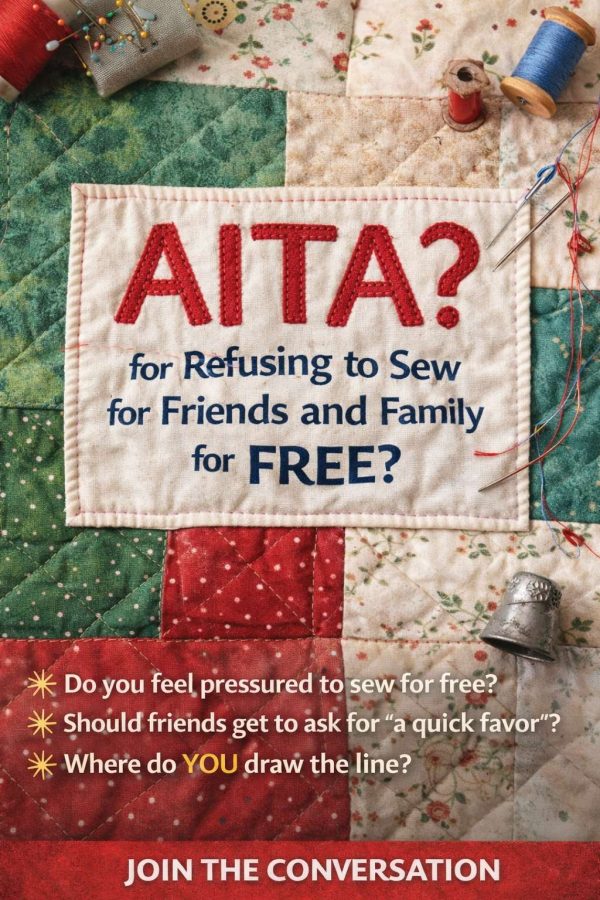
- Have you ever felt pressured to teach sewing?
- Do you enjoy teaching, or avoid it?
- Should skilled sewists be expected to share?
- Where do you draw the line?
Scroll down and add your voice to the conversation.
This is one of those topics where every experience adds something valuable.
(If you have a sewing dilemma of your own, you can submit it anonymously to Sewing.CraftGossip — sometimes the hardest part is just asking the question.)