 Look at what happens when you get a group of sewers together, all stitching with a common cause. Nikki from You Sew, Girl organized a sewing bee to make bags for the Rainbow Comfort Packs project. In one day, they made… well, I’m not gonna tell you. You’ll have to read her blog post to find out because her accompanying pictures say so much more than just the numbers.
Have you read?
Christmas on a Budget -Scrap Fabric Christmas Gift Bags You Can Use Every Year
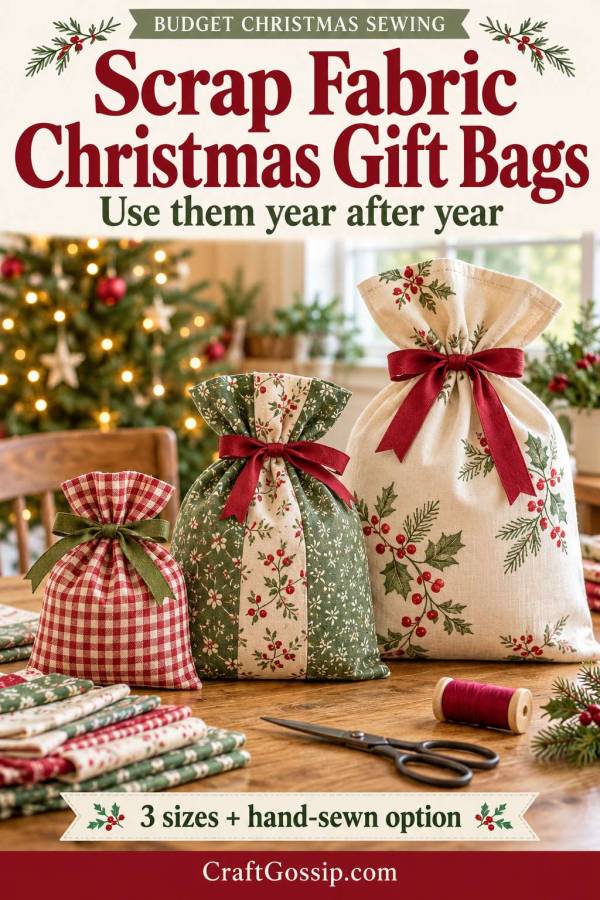
Christmas wrapping is one of those expenses that seems small until you add it all up. Paper, sticky tape, gift bags, bows and ribbon can take a surprising little bite out of the budget, especially when you are already trying to stretch the grocery money.
Then Christmas morning arrives, and much of it ends up in a pile beside the tree.
Reusable fabric Christmas gift bags offer a practical alternative, particularly when you make them from fabric you already own. Leftover quilting cotton, an unwanted pillowcase or the sound sections of a worn cotton shirt can become attractive wrapping that gets used again.
And no, you do not need to buy special Christmas fabric first. That rather defeats the purpose if we are trying to keep spending down.
These beginner-friendly bags use straight seams, a simple hem and a separate ribbon tie. There are no zippers, linings or drawstring channels to wrestle with. You can make them on a sewing machine or sew a small one entirely by hand.
We have shared reusable fabric gift bags in several styles before. This version keeps the construction deliberately straightforward, with the emphasis on using what you have.
Check your cupboards before buying supplies
Start with a small fabric hunt.
Look for:
- Leftover woven cotton from sewing or quilting.
- Unwanted cotton or cotton-blend pillowcases.
- Sound sections of woven shirts, skirts or dresses.
- Lightweight curtains or household linens you no longer use.
- Ribbon saved from previous presents.
- Cotton tape or existing fabric ties.
- Thread in a reasonably coordinating colour.
You do not need perfectly matching thread. A neutral cream, grey or navy often works across several fabrics.
Choose textiles that you are happy to cut up. If an item is still useful as clothing or bedding, consider whether you would rather keep it, pass it on or donate it.
Wash and dry reclaimed fabric before cutting, following its care instructions. Press it flat so you can measure accurately.
Which fabrics are easiest for beginners?
A stable, medium-weight woven cotton is the easiest choice. It stays reasonably flat, presses neatly and does not stretch as you sew.
Avoid very stretchy T-shirts, slippery satin, heavily embellished clothing and fabric that has become thin or brittle. Heavy denim can be difficult to gather at the top and awkward to hand sew.
Hold pale fabric up to the light, too. If the surprise inside will be obvious, choose a more opaque fabric or keep the gift in its existing box.
Project details
Skill level: Beginner
Construction: Unlined, flat gift bag with a hemmed top and separate tie
Sizes: Small, medium and large
Sewing method: Machine or hand sewing
Seam allowance: 1 cm throughout, except for the top hem as described
These bags are wrapping, rather than shopping bags. Support heavier gifts from underneath instead of carrying them by the gathered top or ribbon.
Materials
For one bag, you will need:
- Two fabric rectangles in your chosen size.
- Sewing thread.
- Ribbon, cotton tape or a fabric tie.
- Fabric scissors.
- Ruler or tape measure.
- Pins or sewing clips.
- Iron and ironing board.
- Sewing machine or hand-sewing needle.
- Optional fabric marker or tailor’s chalk.
A rotary cutter and cutting mat are useful if you already have them, but ordinary fabric scissors are perfectly adequate.
Three reusable gift bag sizes
Cut two rectangles for each bag.
All cutting measurements below already include the seam and hem allowances.
| Bag size | Cut two rectangles | Approximate finished size, laid flat |
|---|---|---|
| Small | 22 cm wide × 29 cm tall | 20 cm wide × 25 cm tall |
| Medium | 32 cm wide × 44 cm tall | 30 cm wide × 40 cm tall |
| Large | 47 cm wide × 64 cm tall | 45 cm wide × 60 cm tall |
The finished measurements describe the bag before you gather and tie it. Leave empty fabric above the gift so you can close the top comfortably.
The small bag suits modest items such as jewellery boxes or small craft supplies. The medium is useful for many books and folded accessories. The large can accommodate bulkier presents, depending on their shape.
Check the actual gift before cutting. A flat bag loses usable width as it wraps around a thick object.
For a rectangular box, a useful starting point is a finished flat width greater than the box’s width plus its depth. Allow height for the box, fabric passing underneath it and a generous empty section for gathering.
When in doubt, fold a piece of spare fabric around the gift first.
How to sew a scrap fabric Christmas gift bag
1. Cut your fabric
Cut two rectangles using the size chart.
Keep the longer measurement running from the top of the bag to the bottom. If your fabric has a directional print, check that the design faces upward on both panels.
The front and back do not need to match. A patterned front and plain back can look lovely and make a limited scrap go further.
2. Finish the side and bottom raw edges
For a bag that will be reused and washed, it is worth controlling fraying.
On each rectangle, finish the two long side edges and the bottom edge with a zigzag stitch or overlocker. Keep the finish close to the edge without trimming away a significant amount of fabric.
Leave the top edge unfinished for now. It will be enclosed in the hem.
If you are hand sewing, use the overcasting method explained below.
3. Hem the top of each panel
Place one rectangle wrong side up.
Fold the top edge down 1 cm toward the wrong side and press.
Fold it down another 2 cm and press again. The original raw edge should now be enclosed.
Pin or clip the hem, then stitch close to its lower folded edge.
Repeat for the second rectangle.
This is an ordinary hem, rather than a drawstring casing. The ribbon will wrap around the outside of the finished bag.
4. Sew the bag together
Place the two panels right sides together, matching the hemmed tops, sides and bottom.
Pin or clip around the sides and bottom.
Using a 1 cm seam allowance, sew down one side, across the bottom and up the other side. Leave the hemmed top open.
Backstitch at the beginning and end, especially where the side seams meet the opening.
When turning the bottom corners, stop with the needle down, lift the presser foot, turn the fabric and continue sewing.
5. Turn and press
Turn the bag right side out.
Ease the bottom corners into shape with your fingers or a blunt turning tool. Avoid pushing hard with scissors or anything sharp.
Press the bag, following the fabric’s care requirements.
The bag has a flat bottom seam and will not stand upright on its own. That keeps this version simple and easy to fold away.
If you would prefer a shaped base for boxes, our earlier fabric gift bag tutorial with boxed corners points to another construction option.
6. Add the gift and tie the top
Place the present inside and gather the empty fabric above it.
Wrap ribbon or tape around the gathered section and tie a bow.
As starting lengths, try:
- Small bag: 60 cm.
- Medium bag: 80 cm.
- Large bag: 100 cm.
The length you need depends on the fullness of the bag and your preferred bow. Test with the gift inside before cutting precious ribbon.
There is no need to attach the tie. Keeping it separate makes washing easier and lets you replace it later.
How to make the bag without a sewing machine
The small bag is a manageable hand-sewing project. You can make larger sizes the same way, but they require more stitching.
Cut and press the fabric using the same measurements and folding instructions.
Finish the raw edges by hand
Use an overcast stitch along the sides and bottom of each panel.
Bring the needle through the fabric a few millimetres from the raw edge, pass the thread over the edge and repeat along it. Keep the stitches close enough to contain loose threads without pulling the edge into a tight curl.
Hand sew the top hems
Make the same 1 cm fold followed by a 2 cm fold.
Use small running stitches close to the lower folded edge to hold each hem. Secure the thread firmly at the beginning and end.
Backstitch the side and bottom seams
Place the panels right sides together and mark a stitching line 1 cm from the edges.
Use backstitch for these structural seams:
- Bring the needle up through the fabric a short stitch length ahead of your starting point.
- Insert it back at the starting point.
- Bring it up one stitch length beyond the previous emergence point.
- Insert it back where the previous stitch ended.
- Continue, keeping the stitches small and even.
Stitches around 2–3 mm long are a useful starting point. Secure the thread carefully at the top of each side seam.
Turn, press and tie as for the machine-sewn version.
Hand sewing takes longer, but it also lets you make a gift bag without buying equipment. A slightly wobbly seam does not stop it being useful.
Turn an unwanted pillowcase into a Christmas gift sack
A sound pillowcase can make a particularly easy large gift bag because much of the sewing is already done.
Wash it, check the seams and put the gift inside to test the fit.
If the existing opening works as a bag mouth, gather the fabric above the present and tie it with ribbon. You may not need to alter it at all.
Some pillowcases have an internal flap. Leave it in place if it is not in the way.
To make a shorter sack
Measure the depth you want from the existing opening, then add 1 cm for a new bottom seam.
Cut across both layers at that point.
Turn the pillowcase inside out, sew across the new bottom using a 1 cm seam allowance and finish the raw edges together.
Turn right side out and press.
This preserves the original opening and avoids sewing a new top hem. Check that any shortened sack still has enough empty fabric above the gift for tying.
Make gift bags from suitable clothing
Woven cotton shirts are useful sources of fabric, particularly the back panel.
Start by checking for wear, stains and thin areas. Cut around seams, darts and damaged sections.
For the simplest result:
- Use the shirt back for one panel.
- Cut the second panel from another sound section.
- Keep both panels the same size.
- Avoid bulky seams inside your seam allowances.
If you want to retain a shirt pocket, position it on the outside front of the bag. It can hold a gift tag or card.
Avoid cutting through button plackets for your first bag. Flat fabric is much easier to handle.
Choose your bag size to suit the usable material, rather than buying more fabric to match a predetermined size.
Join smaller scraps into a usable panel
Scraps can be pieced together before cutting your bag rectangles.
Sew strips together with 1 cm seam allowances, finish the raw edges and press the seams.
Once the pieced fabric is large enough, cut the bag panel to the measurement in the chart.
Remember that each join uses fabric. Two strips measuring 12 cm wide become a panel approximately 22 cm wide after joining with a 1 cm seam allowance.
Keep piecing simple. A few broad strips are quicker than dozens of tiny squares.
Save narrower leftovers for another small project, such as an easy fabric bookmark to tuck inside the bag.
Make ordinary fabric feel festive
You do not need a Christmas print.
Try:
- A cream pillowcase bag with red ribbon.
- Blue shirt fabric with a white tie.
- Green cotton with a recycled card tag.
- A floral bag with a small red fabric bow.
- Striped fabric with a handwritten name label.
Choose one repeated colour to bring a mixed collection together.
Removable Christmas tags let the bags work for birthdays and other occasions, too.
If the bag is part of the gift, add a note saying:
“Please keep this bag and use it again.”
For bags staying within your household, make collecting and folding them part of the Christmas tidy-up.
Keep the saving
The biggest saving comes from using existing supplies and making bags you will reuse.
Before spending, ask:
- Do I already have suitable fabric?
- Can I use ribbon I have saved?
- Does this bag need decoration?
- Would a smaller bag fit the gift?
- Am I making a useful replacement for wrapping I would otherwise buy?
Skip lining, interfacing, specialist closures and elaborate trims unless you already have them and want to use them.
Buying new fabric and equipment can make the first batch more expensive than paper wrapping. Start with a few bags from your stash and build the collection gradually.
Your time counts, too. Make one complete bag before cutting a dozen.
Caring for your reusable Christmas gift bags
Remove tags and loose ties before washing.
Follow the care requirements of the most delicate fabric used, wash with similar colours and dry completely before storing.
Check seams before each reuse and repair loose stitches while the job is small.
Keep food in appropriate food-safe packaging inside the bag. Reclaimed clothing and bedding should not become direct wrappers for homemade biscuits or fudge.
Fold the clean bags together and store them somewhere easy to find next Christmas.
A modest stack of handmade gift bags can become a lovely family tradition. They may not all match, and one might always have a slightly crooked seam, but that is part of their charm.
More importantly, they are ready when you need them, with no last-minute hunt for sticky tape.