**THIS GIVEAWAY IS CLOSED**
When I was learning to sew, I kept my mother on speed-dial so she could answer my random sewing questions as they arose. “Uhh, Mom? The pattern is asking for something called interfacing. What is that? And why do I need it?” or “How can I keep that facing from peeking out at the neck?” Her advice was invaluable in helping me avoid mistakes and in giving me confidence to take on more difficult projects.
But what if don’t have an accomplished sewist to call for advice? The Sewing Answer Book might be for you, then.
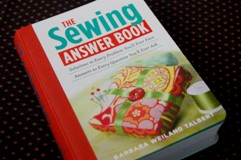 It’s a book of general sewing knowledge organized in a question-and-answer format. From setting up your sewing room, to sewing with patterns, achieving seam and hem finishes, and installing fasteners and closures, this book is chock-full of practical sewing advice. (Over 400 pages of sewing questions and answers!)
At 6.5″ x 4.5″, the dimensions of the book make it easy to keep it at your fingertips on your sewing table or nearby bookshelf. If you’re new to sewing and want to know what all those complicated sewing terms mean, or are perhaps a more advanced sewist wanting to stretch your skills, the information in this book is accessible, relevant, and easy to understand.
 If you’d like a copy of The Sewing Answer Book for your very own, you’ll be happy to know that I’m giving away my review to one lucky Craft Gossip reader. To enter, leave a comment on this post telling me one question you needed the answer to, or one technique you found overwhelming or confusing when you were learning to sew. I’ll choose the winner at random from the comments.
Deadline is midnight CST on Tuesday, July 20, 2010.
[tags]sewing, review, giveaway, book, The Sewing Answer Book[/tags]
OK – I have always wondered – and still guess at -how to properly measure elastic so that it will be tight enough to stay up, but not so tight as to be uncomfortable, and have enough give to ease over the body part it is supposed to go over (like hips/hand/head).
Oh darts confused me when I first started sewing and will be the death of me yet. I can’t get them to lie flat unless it’s a happy accident.
The question I needed answered the other day was… “Why is the thread on the bottom side of my fabric bunching and knotting up as I sew?” The fact the my bobbin carriage (I think that is the name of the dealy) was about to loose a screw when i tried the change the bobbin might be the reason.
Oh I would love this book! I am just starting out and LOVING it.
So many things… when do I need to adjust the tension? what maintenance is needed to keep my machine in shape? which needle for what? do I need to backstitch on decorative stitches – if so, how without messing up the pattern?
I need all techniques… I don’t understand sewing at all. Back in the day in 8th grade I had trouble making a ladybug pillow. When i was first married my hubby bought me a sewing machine. He was thinking I could make all of our clothes including his suits! That machine still exists and I still have trouble threading it, setting the tension, winding a bobbin… I end up with a mess of thread! HELP!!!!!
ooh, i need this!!
no matter how many online tutorials i study, i cannot insert and invisible zipper. please end my pain and let me win this book.
thank you!
Zippers…hands down. After a year of successfully re-teaching myself how to sew, I thought to myself, how hard can it be to sew an invisible zipper? haha. I think I too called my mom, but mostly screaming expletives. Luckily, shortly thereafter my mom came for a visit and showed me how to do them a little bit better…and I’m finally signing up for a class to really get them down.
WOW! I would LOOOOOOOOOVE this book! I am new to sewing–and I have a HUGE machine (actually 3 machines)…and I don’t know how to use them! I would love to learn how to bind a quilt. I have been putting off quilting since I don’t know how to do it! I also would like to know how to sew on a zipper….and how to make pieces match up perfectly (any little trick would help!).
I’ve got my fingers and legs and eyes crossed–hope I win! If not–I am putting this book on my WANT list:) THANKS so much!!
sewing stuff with linings was tricky for me at first. I made a kimono for my sister and about killed myself trying to understand what the words on the pattern meant.
I think the most confusing technique I’ve had to learn recently was bound buttonholes. It took so much googling to find a good set of instructions and images to help me figure it out! 🙂
Since I just began sewing, I have a ton of questions. I don’t understand how to cut out / transfer patterns and be able to use them again or if there’s a correct way to sew & pin fabric together (which side should be on top?).
I would say I have questions about almost everything! I have a Brother electronic sewing machine and have been lucky in that it has a lot of information. But I don’t know the names of a lot of things. It’s all very foreign and almost everything you try to make includes terminology that I guess is basic, but if you’re new to sewing, you might not have that “basic” terminology down.
I find all of sewing confusing, but I’d love win the book for my wife. She’s just starting out with sewing.
Does that count?
I could really use this book. I’m always having questions about sewing and on the internet looking up the answer. It would be much easier to have this book next to me at the sewing machine.
Thanks for the chance to win!
Sewing knits! I’m getting better, but could DEFINITELY use some formal instruction!
Oh, that sounds like a great book. I have been teaching myself to sew mainly from the internet, since there are no good sewing books available in my country.
I seem to struggle with putting in a lapped zipper in the side seam and I have never put in a fly zipper (on pants). I’d like to sew some pants for my son and want to learn how to do that.
I needed help once on lining a jacket. It never did turn out “right”. boo.
and more recently… quilting for non quilters (ie, stitching in the ditch)
Sewing zippers was the technique I needed help on….and the proper way to apply bias tape! I would love this book!
Zippers! I’ve always had tons of questions about how to put them in neatly and easily. There’s got to be a better way. Thanks for the giveaway!
OMG!! this book is so what I have been looking for!!!
i love this book..button holes i mod to work around them or call my mother in law and ask her to show me one more time
i’ve recently started sewing and have done little projects here and there. the one thing that i have trouble with are deciding which stitches to use and how they all work. i could use a good sewing bible. thanks!
I have also called my mom for many sewing questions, including the interfacing question. I thought interfacing was the same as facing. Also, when I made my first dress too big, I called her to see if she thought I could take in the side seams or if I had to take the whole thing apart! This book would be great for those times I can’t reach her by phone.
What is the fisheye dart I keep hearing about?
Thanks for the chance to win Anne! I have been sewing for 40+ years and am still vexed by interfacings! Sew-in, iron-on, weight, woven, arrrgh!!!
I desperately need this book!!
Zippers still give me a lot of grief…I had my mom put one in a skirt I gave up on the last time she visited. 🙂
The one time I used a pattern to sew something, was for my daughters Little Red Riding Hood cape for Halloween last year. Um…it was like reading a freeking forign language! To this day, I am not quite sure how my final product came our somewhat looking like a cape.
My main issue was that patterns seem to assume that you know their “lingo”…..I had to keep calling my mom (who used to be a seamstress for a theater company) to ask her definitions of terms…& she didn’t even know 1/2 of them!
This book looks great!
Well since I have been reteaching myself how to sew since I first learned in 7th grade I would have to ask..what in the world is nap and why do patterns say with nap and without nap on them all the time? This book looks amazing by the way!
I am just starting out, so I frequently have questions. I just recently learned that you need different needles for different fabrics. Glad I found this out before I tried to sew something too thick and broke my needle. Thanks for the chance to win this amazing book!
I was given a (partially broken) serger and would love to learn how to use it!
how do i get the ends of my ruffles ruffly without pulling the threads out of the ends? i always end up with one not ruffly section.
Bias tape will be the end of me. I’ve just gotten into sewing and I’m already way over my head. I’ve made several garments and have done the bias tape different in each one because the previous one just can’t be right…I feel like Russell Crowe in a Beautiful Mind with his delusional theories that just have to make sense… I need this book, my husband and children need me back.
I tried to use my zig-zag stitch to sew on an applique yesterday. It started off OK, but then it kept dropping half of the stitch, so it was just sewing a straight line, rather than a zig-zag. I ended up unpicking the stitches and just sewing a straight-stitch instead. I’m not sure what I was doing wrong!?
Uh, I’d love that book! I want to learn all about all sorts of presser feet. Oh, and sewing curves.
thanks for hosting the giveaway. i want to learn how to sew darts and zippers and pleates.
I’m doing better than than when I first started, but I’m still having some problems with my bobbin thread bunching up every so often. I’m also afraid to try making ruffles.
Oh so many questions! Right now I call my grandma but when working on prjects after the kids are asleep it is too latenfor her as well.
How often do I need to change my needle ?
I’m a newbie to sewing and I really enjoy it. I can’t find enough free time to do much considering I have 2 little girls 4 and under.
This sounds like a wonderful reference book to have.
I still have no idea how to deal with that scary tension knob on my sewing machine, and I would love to learn how to be able to touch it without being afraid of killing my machine and whatever project I’m working on.
I had no idea what “stitch in a ditch” is…. took me forever to figure out!
I didn’t know such a book existed! I’ve always been skeeved by zippers. But…
The ultimate question in (sewing) life:
How do I know when to change the tension/stitch length/stitch width with the type of fabric out there and/or thickness? I’m scared to go any thicker than what I’ve practiced with so far…
Wow, what a great resource! I use my machine CONSTANTLY and still don’t have a very good idea of the proper way to take care of it. How often (and how exactly) should I oil it?
Looks like a great book! I am scared to try a buttonhole. Maybe one day… Thanks for the great giveaway!
Ooh, I need this, what a great giveaway. I want to start with appliques but I wouldn’t know where to start. I have also wondered, is there a certain way to press your seams when quilting?
I have the Crochet Answer Book, and it’s certainly convenient. Right now I’m starting to learn how to draft my own patterns, and have so many questions it’s hard to pick out just one. The transition from bust to waist is particularly difficult to me, and I’ve not yet managed to figure out how princess seams really fit together when I’m designing them myself.
bias tape! Using and/or making it. I have patterns that call for it but i have so far avoided them due to being intimidated! help!! 🙂
Let’s start the beginning…where do I start? I am borrowing a sewing machine and don’t know where to start. I’ve not touched a sewing machine in over 20 years (when I was in middle school home ec class).
How to get my lining and outer material to line up JUST right before I topstitch. I’m plugging away at learning to sew, and this is one that I can’t master, even a little bit!
I love your site, btw… I’m finding it very inspiring and have made a few things from the tutorials you’ve featured. 🙂
I want to know how to gather and how to work with elastic. I’ve only done basic apron dresses for my daughter nothing too difficult. Also I want to know how to put buttons on using the machine. One of my patterns requires buttons in the same place back to back because it’s reversible, but I can’t figure out how to get the 2nd button on. My mom had an idea, but after we washed it the buttons fell off. Needless to say I need this book!
I can use bias tape on straight or slightly curved areas, but can’t figure out how to work it on scallops where there are sharp curves and parts that come to a point.
I’ve been sewing for a long time but I’m still so clueless! I would have to second the many people who have said adjusting the tension. I just have no idea what that’s even about!
Buttonholes! Zippers! I can make things..as long as I can pull them over my head or contain a casing! This book would really help me 🙂
How to put zippers in kids clothes. Especially when the pattern doesn’t call for it. How to adapt patterns to not use elastic.
Why the heck do I need more than one stitch?
What is a serger and is it really that useful?
There are so many feet for a sewing machine. I would love to know what they all do and which ones are really helpful and which ones I can live without.
I struggle with clothing zippers, collars and neck facings.
three words: one step buttonhole! 😀 i’ve been sewing for a year now and just picked up some side work tailoring- i’m sure there are all kinds of handy little tricks i will need to know. i would really love to have this book!
I have always had trouble with adjusting patterns to fit my not-so-perfect body. What are the most crucial areas to make these adjustments?
I do a little of everything in sewing (that doesnt include any sophisticated stitching by the way !)but its mostly trial and error. So while invisible zipper is an issue, a simple bias is also an issue, while darts never come in place they sometimes do not look symmetrical…where do I use larger stitches, where smalla nd how small?
For all the questions need answeringa nd mom has given up hope on my sewing right the first time around , think this book will be a must have !
thanks
Leena
Ha sewing. I’m still a novice. Thank god for clear instructions in sewing guides. I still have a huge amount of problems, some of which I have never solved. However, lining stuff is still a big challenge. I never seem to get the hang of it 🙂
Oh I had sooo many questions when I started sewing about 1.5 years ago. It was from books just like this and the internet that I taught myself. There are so many things I would like to try yet in sewing, like making clothes, that having a book like this on hand would be invaluable.
Thank you so much for the opportunity to win!
How do you stitch in the ditch?
Zippers!!! I can’t read enough tutorials about this, but still haven’t tried.
the hardest thing for me right now has always been sewing in a zipper, i wuld rather chew my own liver.
I NEED this book. Trying to learn sewing on my own is quite challenging. It’s super nice to have a quick little reference book nearby and I haven’t found THE one yet.
Oh, amazing book! My question is: Is there a way to make my sewing machine sew a chain off the fabric? My sewing machine doesn’t like to sew off the fabric or sew a chain after the fabric. Is there a way to make it sew a chain?
🙂
I’m still learning to sew, albeit at a glacial pace as I’m teaching myself (and, between you and me, I’m not a great sewing teacher). I would love to know why my needle keeps losing its thread, despite my having worked with the bobbin tension, and the stitch speed and everything else my sewing machine manual recommends. Thanks!
I’m just learning to sew, so everything perplexes me! What’s worse is I waited till after my mother died to try and learn 🙁 I dug out her old machine and have been trying to figure it all out-I want that connection with her.
There’s just sew much I don’t understand (I may not have mom’s sewing skills, but I do have her sense of humor).
Anything and everything zippers!
I want to learn how to make a nice machine hem on a dress or top.
I am new to sewing and could really use this…so honestly…everything is a question!!!
As a new sewer, I have tonnes of questions that need answering but to top my list is putting zippers in nice and neatly. Thanks for the chance to win what looks like an awesome reference bible!!
The first sewing problem I had (and still do!) was how to fix bobbin tension.
I have a hard time with binding. I also geet confused about interfacing, fusible web, iron on stuff and appliques. I am so new to sewing it is crazy…lol.
Sleeves!! They always give me fits and I end up putting them in more than once. If that book has the answer to that it will be worth its weight in fabric :).
Both my mother and aunt tried to teach me how to sew when I was a young teenager. All we got for our efforts was frustration. Now that I’m older, and hopefully have more patience, I have been trying to practice again. But everything is so new and confusing. Even what thread to use! This book would be a great help since Mom is long distance :).
So, the first thing I ever made was an A-Line skirt…on the bias. Luckily I had an awesome teacher to help me figure out how to make the stretched out waist of the skirt fit the waistband. I remember, when she showed me how to steam it and work it back to it’s original shape(sort of), she said, “You’ve pinned that fabric to within an inch of it’s life!” I think I had like a pin every centimeter or something. It was RIDICULOUS! 🙂
I always have to look up how to fold the fabric to do a machine blind hem, no matter how many times I do it. I have the Knitting Answer Book and Crochet Answer Book, and they are both awesome. Can’t wait to get the Sewing Answer Book, I even have a spot for it in my tote with all my frequently used sewing tools.
I never mastered the art of altering a pattern to fit.
When I was starting out, I called my mom in fits over an invisible zipper. She called me an amateur and taught me the trick. She was my plan B. Now though, she doesn’t sew, and I have no one to call and pester. It’d be nice to be able to take up projects knowing I have a plan B again 🙂
I need to know about hemming men’s dress pants! My DH is short and always needs his pants hemmed. It seems like the front part of the hem gets bunched up over his shoes. What’s a good rule of thumb to remember when hemming-half inch shorter in the front than the back or what?
Would love to win this book, i too have just got back into sewing and everything looks greek to me, i know the basics but would love to be able to sew my own dress!
I have lots of questions, but the one that comes to mind is, how to thread the bobbin correctly. Seems that every time I sew I end up fighting with the bobbin more than actually sewing.
I need help on when to use the various stitches: straight vs. zig zag, etc. I would LOOOVE this book!
Well, i would like to learn how to sew with a machine, and that pretty much summs up all problems, worries and questions i have aboute sewing 🙂
I’m in the middle of learning to sew and have SO many questions. I’m teaching myself sloooooooooowly through online tutorials and sometimes I feel so lost. I can’t even think of a specific question because there are so many. I want to learn to make dresses for my little girl and skirts for both of us, so I guess one of my questions would be what is the best way to make a skirt with an elastic waist?
I would jump up and down if I won! Thanks for the opportunity. 🙂
I still get confused as to which size needle to use in the machine for which type of fabric I am using. There are times I wish there was one universal needle that would take care of all fabric. Same with the different feet.
i would love to learn how to sew knits.
HELP! is there some sort of majic glasses I need so i can make myself clothes?! I can follow simple patterns for my daughters-thanks to my seam ripper-fairly well, but when it comes to making something for me FORGETTABOUTIT ~in my best Tony Soprano voice. everything is waay too loose and makes me look pregnant still. how do i shorten the top half and make the hip tush area a lil bigger in a sundress?
I think the hardest thing for me was to master a large variety of seam finishes. The patterns I used to learn with would give instructions but do not always tell you what the name of the seam finish is. If I needed more help, I couldn’t go look it up in another source because I didn’t know what it was called. I had to bring my pattern instructions to friends who could tell me what it was and (hopefully) give me instructions on how to do it.
i start sewing recently (machin sewing, that is) and following a pattron is still a puzzle. Zippers, didn’t try yet and interfacing and fusible web are a big question mark!
I’ve been trying to master bias tape on a sharp curve – it’s so hard!
As a beginning I am avoiding elastic and bias bindings…the sweatpants and shirts I have tried to make have come out funky and my husband makes fun of me!
I’m a beginner and the several types and brands of interfacing are still very confusing to me. But I love making bags so I really need to master this.
Thanks for the giveaway!
ap_lemos at yahoo dot com
How to fix tears without anyone noticing it’s been repaired.
melodyj(at)gmail(dot)com
What do the various types of seams & stitches correspond to? This is the question that comes to my mind every time I read a tutorial/pattern in English… as I’m French!
Thanks for the chance!
I am an absolute sewing beginner, so most everything is confusing to me!
gathering and I HATE each other- I can always pull the threads and get HALF right, but either the thread breaks, or it wont scrunch anymore. I need a good walk thru on how to sew the threads right!
you were so happy to call your mother all the time, my mother’s answer is practicle, she would rather complete my work than answer me…
i hated too much when i add bias tape to the neck line specially the rounded one, interfacing is better but i dont figure it out till the last minute when i used all the fabric uhhh so i start my mesorry with bias tape, when i finish the dress i always always always stragle with the sleeves i hate it when i be in this level of sewing, i dint knew why i alsys dint make it right. Si what is the easiest way with the round neck finishing and the sleeves adding
I am VERY new to sewing…. I just made my first pillowcase last week during my first class. I am very excited and am making a cosmetic case (with zipper! eek!) for my next project. I hope I win this book, because I may need lots of help indeed….
I’ve been sewing for a very long time, but I still get tense at the thought of buttonholes!
I’d love to win this book! I have been sewing for a few years, but still have LOTS of questions! I’m sure this could help me answer all of them! 🙂
please hw do i measure and cut the princess cut pattern on fabric
I would love to learn how to use the free form sew sewing foot. I bought one and haven’t attempted it yet. What is the correct way to sew with one of these?
please, i need this book!!! i want it
I still have a hard time judging the length of elastic. Sometimes I get it right and sometimes I have to tighten it up.
Would love to win this book!
I would love to win this book,