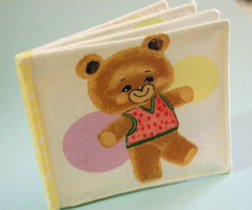
 I recently received a couple of sweet baby prints from Ruby Jane’s Retro Fabric. It’s part of a tutorial exchange hosted by Totally Tutorials. In return for receiving the supplies, I agreed to write a tutorial for a project using said supplies.
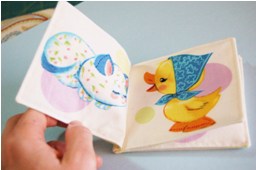
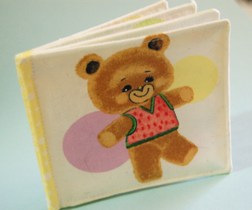
The fabrics I received were from Avelyn’s Rockabye line. It was not hard at all to be inspired by the vintage baby prints!! The images and colors reminded me of baby items from my childhood, and so I thought about some classic baby toys. First up is this fabric book for baby with crinkly pages.
What you need:
— Fabric printed with image blocks. The size of the blocks will be the size of the book. I used the Rockabye Multi Print by Avelyn.
— Lightweight fusible interfacing
— cellophane. If your fabric is light-colored, I’d suggest using a clear cellophane so it doesn’t show throw.
How to make it:
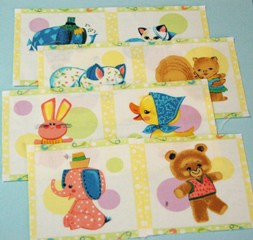 1. Cut out your book pages in sets of two with the sashing in between and a 1/4″ seam allowance around all sides. Here are some things to keep in mind when cutting out your pages:
— Even though you cut them out in pairs, these pairs won’t end up next to each other in the book. Don’t get too attached to your pairings.
— You’ll be sewing two pairs together to create one set of pages. In the book that I made, I used two sets of pages (4 pairs, or 8 blocks total).
— Depending on the repeat of the fabric, you may need to piece together two images to make a pairing. On the fabric that I worked with, there were 9 blocks printed in a 3×3 grid. I could cut 3 pairs straight out of the fabric, but to get the 4th I had to piece. If you need to piece, be sure to include enough seam allowance to create a full sashing in between the blocks.
2. Cut 1 piece of interfacing and 1 piece of cellophane for each block pair. The dimensions should be the same as the block pair MINUS the seam allowances. For example, my block pairs ended up 4″ x 8 1/2″ and I will be using a 1/4″ seam allowance, so I cut my interfacing and cellophane pieces 3 1/2″ x 8″. This will help reduce bulk when you sew your block pairs together.
3. Fuse the interfacing to the backs of each of your block pairs. Center the interfacing so it covers the area that will become the book pages while the seam allowances are left without interfacing.
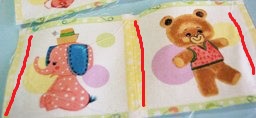 3. Place the cellophane pieces on top of the interfacing and baste in place. I basted down the center and then 1″ from each side. (The red lines in the photo show my basting lines.)
4. Layer your page pairs right sides together and stitch around the edges with a 1/4″ seam allowance, leaving an opening to turn it right side out. I started out with 4 page pairs and ended up with 2 sets stitched together.
5. If your iron is still on, go ahead and turn it to a low setting. You’ll be ironing the pieces in a few minutes and your iron needs some time to cool down or you’ll melt your cellophane!
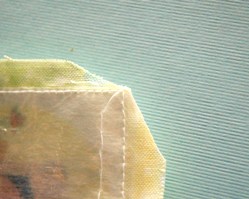 6. Clip corners and turn right-side out. I tend to be fairly ruthless when I clip corners. The more material I can remove and the closer I can cut to the thread, the crisper my corners will be when I turn it right-side out. To cut so close, I use a pair of small, sharp pointed embroidery scissors. I call them my “snippy scissors”.
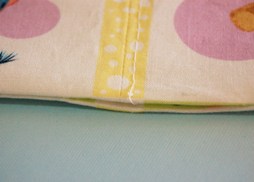 7. Fold the edges of the turning hole inward to create a straight line with the rest of the piece. With your iron on a low setting, press the edges to make them crisp.
If the body of your block pairs got wrinkled while you were turning them right-side out, iron lightly to remove the wrinkles. Remember that there are two layers of cellophane sandwiched in there and you don’t want to melt them! I found that sprinkling with a bit of water before lightly pressing did a good job of removing wrinkles without too much contact with the iron.
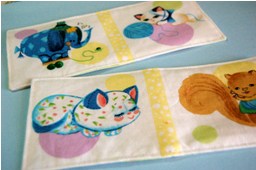 8. Topstitch all sides 1/8″ from the edge. This helps create a crisp edge and it also will close up your turning hole.
.
.
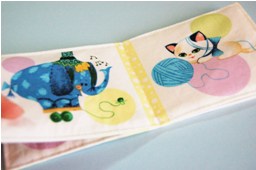 9. Stack the stitched pairs, making sure that the edges are perfectly aligned. Stitch down the very center of the sashing between the block prints. Do a few reverse stitches at the beginning and ending of your seam to lock your stitches.
.
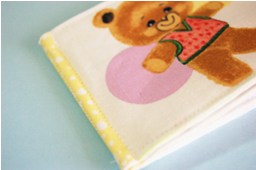 10. Fold in half on the stitch line to create a book. Stitch down the edge of the sashing to create a “spine” for your book.
.
.
You’re done! Place the little book in the hands of a sweet little baby and watch with pride as they enjoy the pictures and feel the crinkle of the pages.
 For this fabric, and many other retro-themed prints, visit Ruby Jane’s Retro Fabrics. Keep up with store news at Ruby Jane’s blog.
[tags]sewing, tutorial, baby, book, crinkle, crinkly, page, Ruby Jane’s Retro Fabrics, Rockabye[/tags]



So cute! I love it! Will have to give this a go for my girlfriend’s new baba! Thanks so much, Sarah
This looks awesome! I totally am going to try it!!
WOW! I love your tutorial, love the crinkly idea, and LOVE those fabrics!!
Hi, I was wondering what kind of cellophane you used? There are so many different kinds out there, and are any safer for the baby than others? Is there a specific kind that crackles more than others? Thanks in advance! I can’t wait to try this!
I am trying to make a book like this…and have bought 2 types of cellophane..neither worked, the stitches just wripped right through the cellophane, is there a certain kind/brand/store you used? can you email me back at [email protected]? thanks!
So cute! I’m wondering the same thing as Sara though. The cellophand just rips out like a coupon. How do I make this not happen?
I used a basting stitch to keep the cellophane in place. On my machine, it’s a 5. (My regular stitch setting is usually a 2.3) The basting stitches are roughly 1/4″ to 3/8″ long, which gave enough distance between the holes to keep it from perforating. –Anne
Can you tell me how I would wash this kind of book when it’s been slobbered on and spit up on by my baby’s baby-friends? Thanks 🙂
Kayli, The thought of this book getting that much love makes me so happy! 🙂 I’d suggest washing it by hand with cold water. Gently wring out the excess water, and then lay it out to dry. Cotton tends to wrinkle so you may need to iron it lightly. Use as cool a setting as possible on your iron, and put a pressing cloth in between to prevent the heat from melting the crinkly pages. –Anne